People ask, “what do veneers look like?” because too many smiles online look overly manufactured. In real life, good veneers usually do not announce themselves from across the room.
A well-made veneer is a thin shell bonded to the front of a tooth to improve color, shape, size, or minor alignment. When it looks natural, it reflects light in a way that resembles enamel, the hard outer layer of the tooth. If you want more detail on materials, read what veneers are made of.
Natural-looking veneers are rarely one flat shade of white. Real teeth have small shifts in brightness, soft translucency near the edges, and subtle surface texture that keeps them from looking plastic.
The best veneer cases often look unremarkable in the best way. Nothing seems oversized, chalky, or unnaturally uniform, and that is usually the goal.
At Simply Veneers in Newport Beach, our veneers service focuses on natural-looking, conservative results and provides the kind of work described here.
If veneers look believable, it is usually because the dentist and lab respected facial proportions instead of chasing a trend. Tooth length, width, edge shape, and smile line all affect the final result.
One of the biggest factors is light reflection and translucency. Enamel is not fully opaque, so veneers that are too dense or too bright can look flat, especially in daylight.
Surface anatomy matters too. Real teeth have tiny ridges, line angles, and texture that break up light. Veneers that are overpolished and perfectly smooth can look fake even when the color is attractive.
Gum integration is another giveaway. If the margin, or edge where the veneer meets the tooth, looks bulky or traps plaque, the restoration may stand out and the gum may become irritated.
Lip support also affects appearance. Veneers that are too thick can push the lips outward slightly and create a strained look when speaking or smiling.
Bad veneers usually fail in obvious ways. They may look too long, too wide, too opaque, or too identical from tooth to tooth.
A common problem is bulky, horsey-looking veneers. That often happens when too much material is added, tooth reduction is poorly planned, or the final contours ignore the natural arch of the smile.
Another problem is using one bleach-white shade across every front tooth. That may photograph well under certain lighting, but in person it often looks harsh and artificial.
Square edges can also be an issue. Some smiles suit a stronger, more angular design, but when every tooth has the same blunt shape, the result can look like one continuous strip instead of separate teeth.
The gumline tells the truth quickly. If the gums look puffy, uneven, or dark around the edges, the veneers may not be fitting well or may be making hygiene harder.
Not all veneers look the same because not all veneers are made the same way. Read about different types of veneers to understand the options. The two main categories are porcelain veneers and composite veneers.
Porcelain veneers usually offer better depth, gloss stability, and stain resistance. They often mimic enamel more convincingly because the material can be layered and shaped with more control in a dental lab.
Composite veneers are built directly on the tooth or made indirectly from resin-based material. They can look good, especially for smaller cosmetic changes, but they may lose polish faster and can stain more easily over time. If you want a closer look at that option, see composite veneers.
That does not mean composite always looks bad. It means expectations should be realistic. For some patients, it is a practical option, while others may want the longer-term polish and color stability porcelain can provide.
Online before-and-after photos are often taken in flattering light and edited for contrast. A veneer case that looks stunning on a phone screen may look very different in daylight, at conversation distance, or while speaking.
Static photos also hide thickness, speech changes, and how the veneers meet the gums. If a practice cannot show close-up views, side views, and natural-light examples, that is worth noticing.
There is no single ideal veneer shape. A smile that looks balanced on one face may look completely off on another.
The amount of tooth shown at rest matters. So does how much gum shows during a full smile. A dentist should also consider facial symmetry, lip mobility, and whether the existing teeth are worn, crowded, or uneven.
Age matters too. Younger natural teeth often show more edge translucency and texture. Older teeth may look slightly flatter or darker from wear, so veneers that ignore those patterns can look disconnected from the rest of the face.
This is where cosmetic dentistry can go wrong. Patients are sometimes sold the same social-media smile regardless of bone structure, speech pattern, or bite. That is not true personalization.
When a patient needs a broader plan that respects facial balance, gumline, and bite, a smile makeover can combine treatments to create a cohesive, natural result rather than forcing every smile into one template.
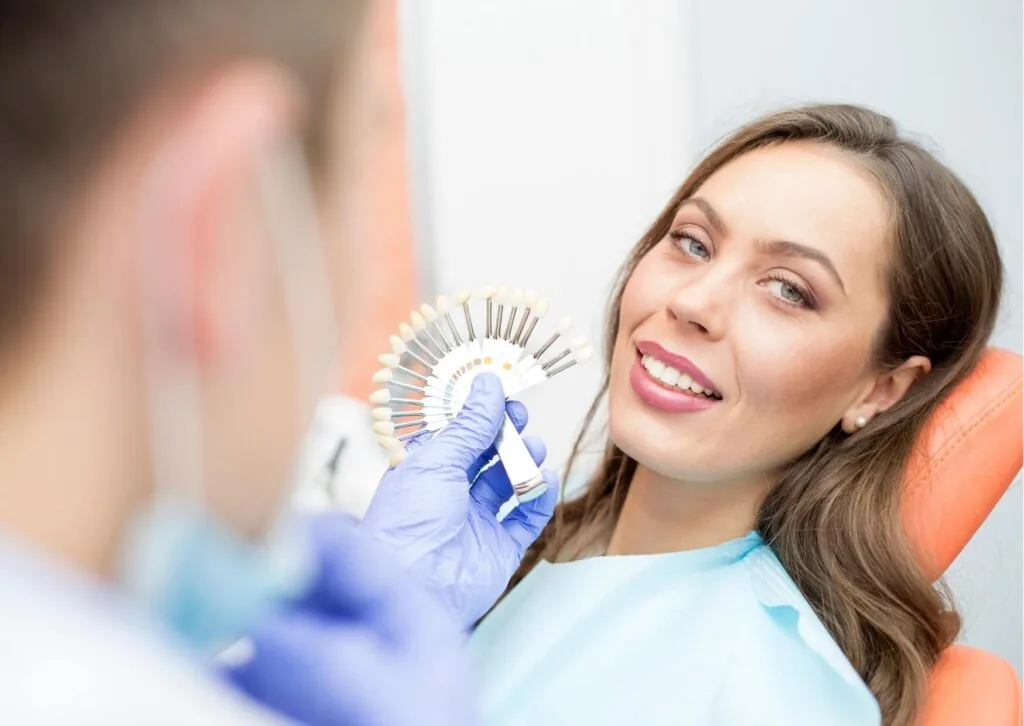
If the question is what do veneers look like, the better question may be what they will look like on your own teeth and face. That cannot be answered responsibly in a rushed sales consult.
A proper evaluation may include photos, X-rays when needed, bite analysis, and a review of gum health. If there is active decay, gum disease, clenching, or unstable bite force, those issues matter before cosmetic work starts. Good veneer preparation starts with a solid pre-treatment assessment and helps prevent bulky margins and poor fit.
Ask to see examples that resemble your starting point, not just ideal makeover cases. Ask whether a mock-up or temporary preview is possible so you can judge shape and length before the final restorations are made.
If you want to preview your design in your mouth, consider a smile tryout to see how proposed veneers sit with your lips and speech.
If you're unsure whether veneers are right for you, read our blog, should you get veneers.
Be careful if a provider promises a perfect smile without discussing enamel removal, bite stress, or long-term maintenance. Be careful if every case shown is the same blinding white shade.
Another red flag is pressure to do many teeth without a clear reason. Some patients benefit from multiple veneers. Others need a smaller, more conservative plan, whitening, bonding, orthodontic treatment, or no veneers at all.
Sometimes veneers look wrong because something is wrong. Aesthetic problems can overlap with health and function.
If veneers suddenly feel high when biting, chip repeatedly, trap food, or make floss shred, the fit may need evaluation. If the gums bleed, swell, or recede around them, that also deserves attention.
Urgent dental review is sensible if there is severe pain, a loose veneer, facial swelling, fever, trauma, or a broken restoration exposing a sharp edge or sensitive tooth structure. Those issues go beyond appearance. Common veneer complications can also include sensitivity and irreversible enamel changes, which is why warning signs should not be brushed off.
Speech changes can matter too. Slight adaptation is common after dental work, but persistent lisping or awkward lip posture may mean the veneers are too thick or too long.
A cosmetic result should not require pretending everything feels normal when it does not. Teeth are not props. They have to function every day under real force.
The honest answer to what veneers look like is this: the best ones do not look like veneers first. They look like teeth that belong to the person wearing them.
That means balanced color, believable translucency, clean edges, healthy gum response, and shapes that fit the face instead of fighting it. It also means a plan grounded in diagnosis, not vanity marketing.
Patients deserve a result that respects biology, function, and identity. A good smile upgrade should feel like relief, not disguise.
Simply Veneers in Newport Beach, CA, offers veneers and related cosmetic services for patients seeking natural, long-lasting results; we serve Newport Beach and nearby areas including Huntington Beach and Irvine, and you can call (949) 777-1000 to schedule a consultation.
They can, but they do not have to. Veneers often look fake when they are too white, too opaque, too bulky, or all shaped the same across the front teeth.
Sometimes, yes, especially if the design is very bright or oversized. Well-made veneers are often hard to identify casually because they blend with facial features, gum contours, and natural tooth texture.
No. Many natural-looking veneer cases use softer shades with variation and translucency. Extremely white veneers are a style choice, not a requirement.
Often they do, mainly because porcelain can hold gloss and optical depth better over time. Composite can still look good, but the finish may change faster with wear and staining.
Schedule a dental evaluation with a clinician experienced in cosmetic and restorative dentistry. The cause may involve contour, thickness, bite, or gum response, and the right next step depends on the exam.




