Yes, teeth whitening strips can work. That is the short answer, but it leaves out the part patients actually need to know: what strips can improve, what they cannot change, and when they may make an existing problem feel worse.
Many patients buy whitening strips hoping for a quick fix before photos, work events, dating, or just to feel better about their smile. Then they use them exactly as directed and end up with uneven results, mild improvement, or sharp sensitivity they were not expecting.
That frustration makes sense. Whitening is often sold like a simple beauty product, but tooth color is affected by enamel thickness, stain type, fillings, age, and underlying dental problems.
So yes, whitening strips can lighten certain stains. They work best on otherwise healthy teeth with mild to moderate yellowing and realistic expectations.
At Simply Veneers in Newport Beach, CA, our teeth whitening service provides the kind of supervised care many patients are actually looking for.
Most whitening strips use a peroxide-based gel. Peroxide breaks down stain molecules within the outer tooth structure, which changes how teeth reflect light and makes them look whiter.
That process is real, and it is why strips can create visible improvement. But the result depends on the type of stain, how well the strip contacts the teeth, and whether the discoloration is something peroxide can actually change.
Whitening strips do not paint teeth white. They work by breaking up stain molecules, which is why yellowing from coffee, tea, tobacco, and normal aging often responds better than gray, brown, or patchy discoloration caused by trauma, enamel defects, or certain medications.
If a tooth looks dark because the nerve is damaged, the enamel developed abnormally, or a filling changed color, strips may do very little. In some cases, they can make the mismatch more obvious by whitening nearby teeth but not the darker area.
Whitening strips usually work best on mild to moderate yellow staining. That includes common discoloration linked to aging, coffee, tea, red wine, and smoking.
They also tend to work better when the front teeth are smooth and fairly straight. A strip can only whiten the areas it touches well, so crowded, rotated, chipped, or uneven teeth may whiten unevenly.
Patients often get the most predictable result when they have healthy enamel and no active gum inflammation. Mild surface staining and age-related yellowing are the most common situations where over-the-counter strips help.
Even then, expectations matter. The result is usually a modest brightening, not the perfectly uniform white shade often shown in edited photos or cosmetic ads.
If you want a broader cosmetic result, combining whitening with other treatments is common. A full smile makeover can create better balance when whitening alone is not enough, and you can read more about should I get veneers if you are weighing that option.
This is where many patients feel disappointed. Whitening strips do not work well on crowns, veneers, bonding, or tooth-colored fillings because those materials do not respond to peroxide the way natural enamel does.
They may also fall short when stains are deep, uneven, or caused by internal changes in the tooth. Intrinsic discoloration, a single dark tooth, white spots, or brown enamel defects often need a different diagnosis before any cosmetic treatment makes sense.
Fit is another limitation. A strip is flat, but teeth and gumlines are curved, so uneven whitening is a common problem.
That matters more than many people expect. If one front tooth has a filling, another has a crack line, and another sits slightly behind the others, the final shade may look inconsistent even if the product technically worked.
When whitening cannot fix the mismatch, longer-lasting options such as veneers may create a more uniform color and shape. If you are comparing options, read the pros and cons of veneers.
Whitening sensitivity is common. It often feels like short, sharp zings from cold air, cold drinks, or even breathing through the mouth.
That happens because peroxide can trigger sensitivity by temporarily increasing fluid movement inside tiny channels in the tooth called dentinal tubules. In simple terms, the tooth becomes more reactive for a while.
Gum irritation can also happen if the gel sits on soft tissue instead of enamel. Tooth sensitivity and gum irritation are the side effects patients notice most often.
Some people are more likely to struggle with this. Existing sensitivity, gum recession, worn enamel, cracks, untreated cavities, and recent dental work can all make whitening less comfortable and less appropriate.
If pain is strong, getting worse, or lasting beyond the whitening period, it is safer to get a dental exam. Not every painful tooth after whitening is just routine sensitivity.
This is the part patients deserve to hear clearly. Sometimes people are trying to solve a dental problem with a cosmetic product.
If teeth look darker because of plaque buildup, tartar, cavities, leaking fillings, enamel erosion, or a dying tooth, strips do not fix the cause. They may delay treatment while the real issue gets worse.
Bad breath, bleeding gums, pain when biting, one tooth turning darker than the others, visible holes, swelling, or pus are signs that need a dental evaluation. Those are not typical whitening-strip issues.
If you are not sure why your teeth look stained, a visit focused on cosmetic dentistry can help clarify whether you need simple whitening or a more complete treatment plan.
The same is true after trauma. If a tooth darkens after being hit, the problem may be internal damage, and that needs diagnosis rather than repeated rounds of over-the-counter whitening.
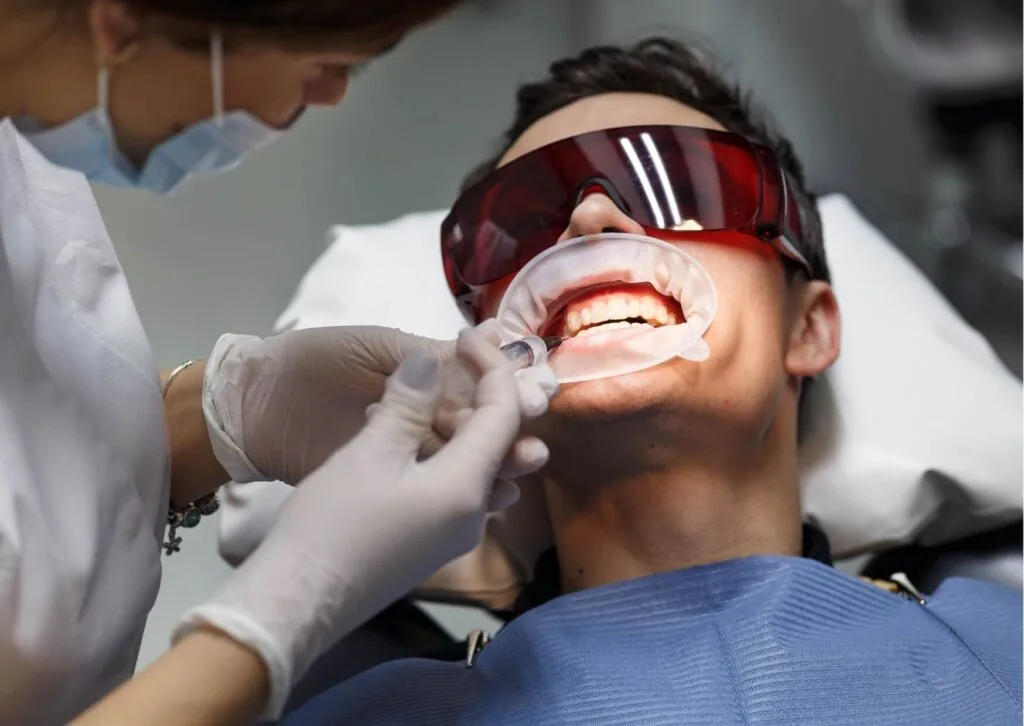
Professional whitening is not automatically better for every patient, but it is usually more controlled. A dentist can check whether your teeth and gums are healthy enough for whitening, identify restorations that will not change color, and recommend an approach that fits the stain pattern.
Over-the-counter strips are cheaper and easier to buy. For mild staining, that convenience may be enough.
Still, many patients end up in the dental chair after trying strips first. Professional whitening is usually more customized and predictable.
Here is the practical comparison:
| Feature | Whitening Strips | Professional Whitening |
| Access | Easy to buy at pharmacies and big-box stores | Requires dental evaluation or dental purchase |
| Best for | Mild to moderate generalized staining | Broader range of cosmetic cases |
| Fit | One-size approach | Customized trays or in-office application |
| Speed | Gradual | Often faster |
| Sensitivity management | Limited | Better supervision and adjustment |
| Work on fillings/crowns | No | No, but mismatch can be planned for |
| Diagnostic value | None | Includes assessment of causes and risks |
The main point is not that strips are useless. It is that they are a consumer product trying to solve a problem that may be cosmetic, clinical, or both.
If whitening strips leave you with patchy results or lingering sensitivity, a visit focused on cosmetic dentistry can help map out safer, longer-lasting options.
Some patients should pause before using whitening strips, even if the packaging makes the process look simple. This includes anyone with untreated cavities, active gum disease, significant sensitivity, exposed roots, cracked teeth, or several visible restorations on the front teeth.
Caution also makes sense for patients with braces, recent dental procedures, or patchy white or brown enamel spots. In those situations, whitening may create a more uneven appearance or trigger discomfort.
Children, teenagers, and pregnant patients should not make whitening decisions based only on social pressure or marketing. A dentist should guide whitening when the situation is medically unclear.
That is not about gatekeeping. It is basic risk control.
A realistic result is a cleaner, brighter version of your current tooth color. It is not a total reset, and it is rarely a perfectly uniform celebrity-white shade.
Natural teeth vary in color from edge to gumline. They also change with age as enamel thins and the deeper dentin underneath becomes more visible.
That is why chasing extreme whiteness can become frustrating. Healthy-looking teeth do not need to be paper white.
A better question is not just whether strips can make teeth lighter. It is whether the final result will still look natural, comfortable, and consistent with the rest of your smile.
Stop using whitening strips and contact a dentist if you have severe sensitivity, gum burning, mouth sores, facial swelling, or pain that feels deep, throbbing, or focused on one tooth. Those patterns may point to something more than routine whitening irritation.
A dental visit is also a smart next step if the color change is uneven, one tooth stays dark, you already have fillings or crowns in the smile zone, or the result is disappointing despite proper use. In those cases, the issue may be the diagnosis, not the effort.
Urgent care matters if there is swelling, fever, drainage, or trauma followed by discoloration. Swelling, severe pain, or one dark tooth should not be brushed off as a cosmetic issue.
Whitening is elective. Protecting the tooth is not.
So, do teeth whitening strips work? Yes, often enough to brighten mild staining, but not enough to live up to every promise made on the box.
They can be a reasonable option for healthy teeth with common yellow discoloration. They are a poor substitute for diagnosis when the color change is uneven, painful, sudden, or tied to an underlying dental problem.
Patients deserve clear information, not just cosmetic marketing. If you want a whiter smile without guessing through sensitivity, wasted money, or missed dental issues, a dental exam is often the smartest first step, even if the final plan is simple.
If you prefer professional whitening at Simply Veneers in Newport Beach, CA, serving patients from Huntington Beach and Irvine, call (949) 777-1000 to schedule teeth whitening.
You can also read how we enhance your smile with precision and beauty.
Often, yes. Yellow staining from food, drinks, smoking, and normal aging usually responds better than gray or brown discoloration.
Many patients notice some change within a few days to a couple of weeks, depending on the product and the starting stain level. Results vary, and using more than directed can increase sensitivity without improving the outcome.
When used as directed on healthy teeth, they do not usually cause permanent enamel damage. But they can trigger sensitivity and irritate gums, especially if there are cracks, exposed roots, or untreated dental problems.
Uneven fit is one common reason. Fillings, crowns, crowding, enamel defects, and different stain depths can also make the final result look patchy.
If your teeth are healthy and the staining is mild, some people try strips first. If you have pain, one dark tooth, bleeding gums, visible decay, or heavy sensitivity, seeing a dentist first is the safer choice.




