Veneers for crooked teeth can make a mildly uneven smile look straighter, but they do not move teeth or fix bite problems. If crowding, rotation, or bite issues are more than minor, braces or clear aligners are usually the more conservative and healthier choice.
If you're unsure whether camouflage or tooth movement is the right choice for mildly crooked teeth, veneers can often show how subtle reshaping improves appearance without moving roots. At Simply Veneers in Newport Beach we use conservative designs and digital previews to clarify expected changes and preservation of enamel.
A veneer is a thin shell, usually porcelain or composite resin, that covers the front of a tooth. A dentist can design veneers to mask small rotations, uneven edges, narrow teeth, minor gaps, and slight differences in tooth position.
This is sometimes called “instant orthodontics,” but that phrase can be misleading. Veneers change appearance, not tooth position, and they do not correct malocclusions or treat an overbite, underbite, crossbite, or significant crowding.
The result depends on where each tooth sits in the arch. A tooth that sticks out may need more enamel reduction to fit a veneer naturally, while a tooth that sits farther back can sometimes be built outward more conservatively.
Veneers and orthodontics solve different problems. Veneers camouflage cosmetic concerns, while braces and clear aligners move natural teeth into better positions.
|
Option |
What It Does |
Typical Advantages |
Important Limits |
|---|---|---|---|
|
Porcelain veneers |
Covers the front of teeth |
Highly stain-resistant; can improve shape, color, and apparent alignment |
Usually requires enamel removal; irreversible; does not correct the bite |
|
Composite veneers |
Adds tooth-colored resin |
Often requires less preparation; easier to repair; lower initial cost in many cases |
More prone to staining, chipping, and wear than porcelain |
|
Clear aligners |
Moves teeth with removable trays |
Preserves natural enamel; discreet; may improve alignment and bite |
Requires consistent wear; not appropriate for every movement |
|
Braces |
Moves teeth with fixed brackets and wires |
Treats many complex alignment and bite concerns |
More visible in many designs; treatment takes time |
Orthodontics is often the better choice when teeth are healthy in shape and color but simply out of position. If the main problem is alignment rather than color, wear, or shape, moving the teeth is usually more conservative than covering them.
Some patients benefit from aligners or braces first, then limited bonding or veneers if proportions, discoloration, or worn edges still need improvement. For a comparison, read bonding vs. veneers.
A personalized smile makeover can combine orthodontics, whitening, and conservative restorations when several concerns overlap.
The main advantage is that veneers can improve several visible issues at once, including color, shape, length, symmetry, and apparent alignment. For a broader overview, see pros and cons of veneers.
Treatment may also be faster than orthodontics, but speed should not come at the cost of healthy enamel. Hiding severe rotation with aggressive tooth reduction can increase the risk of sensitivity, nerve irritation, or more extensive dental work later.
If you are concerned about long-term effects on natural teeth, read Are veneers bad for teeth. Veneers also need enough healthy enamel for reliable bonding.
Research consistently shows veneers bonded to enamel perform more predictably than veneers bonded more heavily to dentin. Active cavities, gum disease, major enamel loss, untreated grinding, or a bite that places too much force on the veneers may make treatment unsuitable until those issues are addressed.
Porcelain veneers often last many years, but they should not be viewed as permanent. Read how long veneers last for more detail.
Porcelain veneer longevity depends on the bite, preparation design, bonding surface, oral hygiene, material quality, grinding habits, and hard impacts. Composite veneers usually need maintenance or replacement sooner because resin can stain, roughen, or chip more easily.
A veneer will eventually need repair or replacement. Once enamel is removed, the tooth will need ongoing restoration over time.
Avoiding ice chewing, package opening with the teeth, and other hard-force habits can reduce preventable damage. If grinding is present, a dentist may recommend a nightguard.
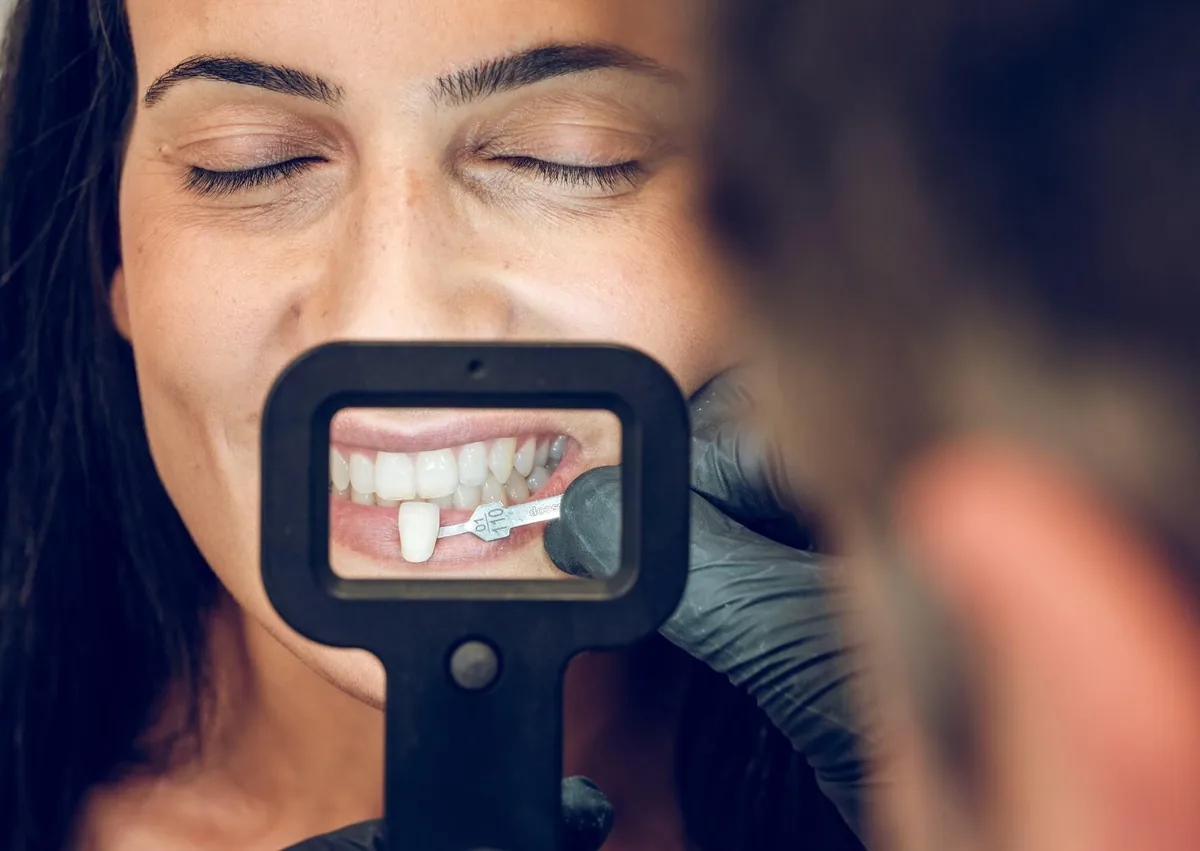
The first visit usually includes an exam, photos or scans, and X-rays when needed. Your dentist also evaluates the bite, gums, and how much change is possible without overpreparing the teeth.
A digital preview or complimentary smile tryout may help show how changes in width, length, and symmetry could look. It is helpful for planning, but it does not guarantee an exact final result.
For porcelain veneers, the teeth are commonly numbed before a small amount of enamel is reshaped. Scans or impressions are then taken, and temporary veneers may be placed while the final restorations are being made.
At the bonding visit, the dentist checks fit, color, contacts, and bite before attaching the veneers. Mild sensitivity or gum tenderness can happen for a short time afterward.
Severe pain, increasing swelling, fever, facial swelling, a loose veneer, or a bite that feels sharply uneven should be evaluated promptly. Composite veneers may be placed in one visit in appropriate cases, with little or no lab time.
A good candidate usually has mild cosmetic misalignment, healthy teeth and gums, enough enamel for bonding, and realistic expectations. Good home care and a willingness to maintain and eventually replace the restorations also matter.
Veneers may be a poor first choice when teeth are severely crowded, strongly rotated, protruding, or part of an unhealthy bite. A history of frequent cavities, active gum disease, uncontrolled clenching or grinding, or too little enamel can also change the recommendation.
Age matters too. Veneers are usually approached more cautiously in younger patients whose teeth and gums may still be changing, especially when orthodontic treatment could preserve healthy enamel.
Schedule a cosmetic and bite evaluation if crooked teeth affect your confidence and you want to compare camouflage with true tooth movement. A thorough consultation should explain how much enamel would be removed, whether orthodontics could reduce that need, and what the result can and cannot realistically achieve.
Ask to see a design based on your own teeth rather than relying only on generic before-and-after photos. If a plan involves extensive reduction of healthy teeth, getting a second opinion from another dentist or an orthodontist can help clarify more conservative options.
A personalized exam is the only reliable way to decide whether veneers, bonding, braces, clear aligners, or a combined plan best fits your teeth and bite. Evaluating the issue early can also make treatment choices simpler if crowding is starting to affect hygiene, wear, or gum comfort.
A personalized preview or combined cosmetic plan is the clearest way to compare veneer camouflage with orthodontic movement and protect healthy enamel. Call Simply Veneers for veneers in Newport Beach at (949) 777-1000 to arrange a consultation or book an appointment.
Veneers may visually disguise mild misalignment, but very crooked teeth often need braces or clear aligners. Covering severe rotation or protrusion may require too much enamel removal and still will not correct the roots or bite.
Porcelain veneers commonly require some enamel reduction, although the amount varies. No-prep or minimal-prep veneers work only for selected tooth positions and can look bulky if there is not enough space.
Veneers can create a cosmetic change in fewer visits, while aligners usually move teeth over a period of months. The faster option is not automatically the better one because veneers permanently alter the tooth surface and do not treat underlying alignment.
The veneers do not move on their own, but the teeth underneath them can shift over time. Bite changes, gum recession, wear, or chipping can also change the appearance, and retainers may be recommended after prior orthodontic treatment.
Dental insurance often classifies veneers as cosmetic and may not cover them. Coverage varies by plan, so request a written estimate and confirm benefits directly with the insurer before treatment. See insurance for veneers for more information.




